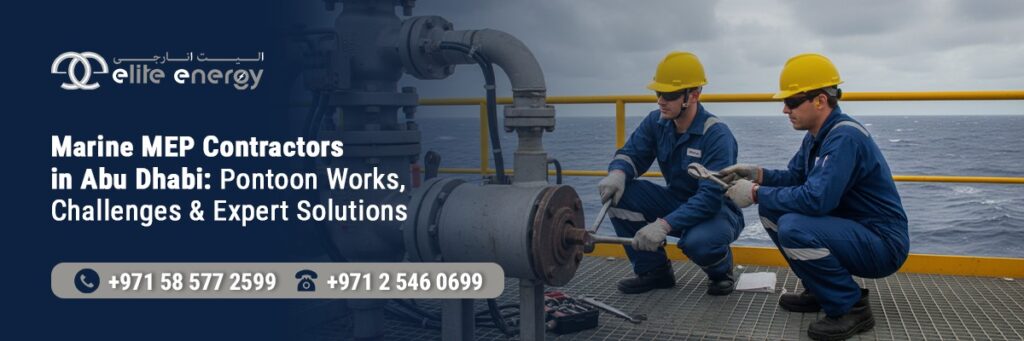
Marine projects may look straightforward from the outside, but the engineering systems behind a marina, pontoon, gangway or waterfront facility have very little room for error. Marine MEP Installations need to perform in an environment where saltwater, humidity, movement, restricted access and constant exposure can quickly turn a small installation issue into a major operational problem.
Unlike conventional building projects, marine facilities are exposed to conditions that can affect electrical equipment, plumbing networks, lighting, mechanical systems and connections over time. A system that works perfectly on land may require a completely different approach when installed beside or over water.
That is why marine MEP work requires more than simply installing electrical cables, pipes or equipment. It requires careful planning, suitable materials, accurate drawings, coordinated installation and an understanding of how marine environments affect every component.
For projects in Abu Dhabi and across the UAE, experienced marine MEP contractors can help project owners address these challenges before they become expensive repairs or safety concerns. Elite Energy provides marine MEP design and shop drawings as well as solutions for marine electrical and plumbing systems, including pontoon pedestals, gangways and bank seats.
What Makes Marine MEP Installations Different?
Marine MEP systems have to operate in an environment that is considerably harsher than a typical commercial or residential development.
A waterfront project may experience:
- Continuous exposure to saltwater and moisture
- High humidity and temperature variations
- Wind and weather exposure
- Movement and vibration in floating structures
- Limited access for maintenance
- Restricted installation space
- Corrosion of unsuitable materials
- Complex electrical and plumbing connections
- Heavy dependence on reliable lighting and power
- Difficult repair conditions once the facility is operational
These factors influence everything from material selection to cable routing and equipment positioning.
For example, a pontoon electrical system cannot be planned exactly like an indoor commercial electrical installation. Equipment may need additional protection, connections need to be positioned carefully, and the installation must accommodate the movement and operating conditions of the structure.
Good Marine MEP Installations therefore begin at the design stage rather than when technicians arrive on site.
Key Challenges in Marine MEP Installations
Corrosion and Saltwater Exposure
Corrosion is one of the biggest concerns in marine engineering.
Saltwater and humid air can accelerate deterioration in exposed metal components, electrical connections, fasteners, support systems and plumbing components. If inappropriate materials are selected, the installation may require premature replacement or frequent maintenance.
A professional approach considers the marine environment before materials are purchased.
Depending on the application, engineers may need to consider:
- Corrosion-resistant materials
- Suitable cable glands and connectors
- Proper equipment enclosures
- Protective coatings
- Marine-grade fixtures and accessories
- Appropriate supports and mounting systems
- Sealed electrical connections
The objective is not simply to install a system that works today. It is to create a system that can continue operating reliably after prolonged exposure to the marine environment.
Electrical Safety Near Water
Electricity and water create an obvious safety concern, making marine electrical systems particularly sensitive.
Power distribution for pontoons, marina facilities and waterfront structures must be carefully designed. Cable routing, grounding, protection devices, equipment positioning and connection points all need to be considered as part of the overall safety strategy.
A reliable marine electrical installation should account for:
- Proper cable selection and routing
- Protection against moisture
- Suitable electrical enclosures
- Earthing and bonding
- Protection against electrical faults
- Safe equipment access
- Emergency considerations
- Inspection and testing
Elite Energy provides electrical contracting capabilities that include LV systems, lighting, cable systems, earthing and power distribution, which can form part of an integrated marine MEP approach.
The key is coordination. Electrical systems should not be treated as an isolated package when they share space and interfaces with mechanical and plumbing installations.
Working With Limited Space
Space is often a major constraint in marine projects.
A floating pontoon or compact marine facility does not offer the same amount of accessible service space as a large commercial building. Electrical cables, water lines, drainage, lighting equipment and other services may need to occupy carefully planned routes without interfering with structural components or pedestrian areas.
Poor planning can create several problems:
- Difficult access for maintenance
- Congested service routes
- Increased installation time
- Greater risk of damage
- Difficult equipment replacement
- Unnecessary visual clutter
This is where detailed shop drawings become valuable.
Before installation begins, the contractor can coordinate service routes, equipment locations and connection points to identify conflicts early. Elite Energy specifically provides end-to-end marine MEP design and shop drawings for systems ranging from pontoon pedestals to gangways and bank seats.
Good coordination at this stage can save considerable time during installation.
Movement and Structural Flexibility
One of the most important differences between land-based and floating marine infrastructure is movement.
Floating structures may move because of waves, changing water levels, vessel activity or loading conditions. MEP connections therefore need to be designed with the structure’s operating environment in mind.
Rigid installation methods that work well in a conventional building may not always be appropriate for floating infrastructure.
Engineers should consider:
- Flexible connections where required
- Cable movement and routing
- Pipe movement
- Equipment mounting
- Connection points between fixed and floating structures
- Expansion and contraction
- Accessibility for inspection
This is particularly important around gangways and transitions between fixed waterfront structures and floating pontoons.
A well-designed system allows the necessary movement without compromising electrical safety, water supply or overall system performance.
Reliable Marine Lighting
Lighting is more than an aesthetic feature in a marine environment. It can influence navigation, pedestrian safety, access and the usability of a waterfront facility after dark.
Marine lighting may include:
- Deck lighting
- Strip lighting
- Access lighting
- Pedestrian-area lighting
- Pontoon lighting
- Feature lighting
- Emergency lighting
Fixtures must be selected with environmental exposure in mind. Installation details also matter because poorly sealed or poorly positioned fixtures can become vulnerable to moisture and corrosion.
Elite Energy’s marine services include the design and installation of deck and strip lighting for marine platforms, with solutions intended to withstand harsh marine environments.
The best lighting design balances visibility, energy efficiency, maintenance access and the overall appearance of the waterfront development.
Plumbing and Water Management
Marine plumbing systems can be just as demanding as electrical installations.
Water supply and drainage systems may need to operate within compact areas while remaining accessible for inspection and maintenance. The contractor must also consider pipe materials, routing, connections, drainage gradients and exposure to the surrounding environment.
Depending on the project, marine plumbing systems may support:
- Water supply points
- Marina utilities
- Wash areas
- Sanitary facilities
- Drainage
- Pumping systems
- Service connections
- Waterfront facilities
The challenge is to create a practical network that can withstand the environment while remaining easy to maintain.
This is why integrated planning between plumbing and electrical teams is important. Pumps, control equipment, electrical supply and drainage cannot be designed independently when they form part of the same marine facility.
Integrating ELV and Communication Systems
Modern marine facilities increasingly depend on low-voltage and communication systems.
A waterfront development may require CCTV, Wi-Fi, access control, communication infrastructure or other ELV solutions. These systems need reliable power and appropriate installation methods to remain operational in a demanding environment.
For example, a marina operator may need connectivity across several areas rather than only inside a single building. This means the infrastructure must be planned around coverage, equipment location, cable routing and environmental exposure.
Elite Energy’s marine support capabilities include ELV and Wi-Fi systems alongside E-Power units and pedestal maintenance.
The advantage of handling these requirements as part of an integrated MEP scope is better coordination between power, communications and physical infrastructure.
How Expert Marine MEP Contractors Overcome These Challenges
Solving marine MEP challenges starts with understanding the project before installation begins.
Begin With a Detailed Site Assessment
A site assessment gives engineers an opportunity to understand the actual conditions rather than relying entirely on drawings.
The assessment can consider:
- Marine exposure
- Existing utilities
- Access limitations
- Structural conditions
- Equipment locations
- Service routes
- Power requirements
- Water and drainage requirements
- Maintenance access
This information becomes the foundation for the installation strategy.
Use Detailed Design and Shop Drawings
Good drawings reduce uncertainty.
For marine projects, shop drawings can show equipment positions, cable routes, pipe routes, connection points and service interfaces before physical installation begins.
This makes it easier to identify clashes between different disciplines.
A coordinated drawing package can also help the project team understand how the final system will look and operate.
Select Materials for the Marine Environment
Material selection should never be an afterthought.
Engineers should consider:
- Corrosion resistance
- Moisture exposure
- UV exposure where applicable
- Mechanical strength
- Expected service life
- Ease of replacement
- Maintenance requirements
- Compatibility with surrounding materials
Choosing a cheaper component that fails early can ultimately cost much more than selecting a suitable product at the beginning.
Coordinate Electrical, Mechanical and Plumbing Systems
Marine projects benefit from an integrated approach.
Instead of having electrical, plumbing and mechanical teams work independently, the systems should be coordinated around the same installation plan.
This helps prevent:
- Cable and pipe clashes
- Poor equipment access
- Conflicting service routes
- Difficult maintenance points
- Last-minute modifications
Elite Energy describes its approach as integrated MEP delivery across marine and other sectors, supported by design, drafting, electrical, mechanical and contracting capabilities.
Test Before Handover
Installation is only one part of the project.
Before handover, systems should be inspected and tested to verify that they operate as intended. Electrical systems, lighting, plumbing connections, equipment and other MEP components should be checked according to the approved project requirements.
Testing and commissioning can help identify issues while the installation team is still available to correct them.
This is particularly valuable in marine projects because access can become considerably more difficult after the facility is operational.
Why Choosing the Right Marine MEP Contractor Matters
A marine MEP contractor is not simply responsible for installing equipment. The contractor has to understand how the systems interact with the marine environment, the structure and the people using the facility.
When evaluating a contractor, consider:
- Experience with marine or waterfront projects
- Electrical and plumbing capabilities
- Ability to prepare shop drawings
- Understanding of marine environmental conditions
- Quality control procedures
- Safety practices
- Testing and commissioning capabilities
- Maintenance and after-sales support
- Ability to coordinate multiple MEP disciplines
A contractor with integrated capabilities can make communication easier because the different systems are managed as part of a coordinated project rather than as disconnected packages.
Elite Energy is an Abu Dhabi-based electro-mechanical contracting company serving sectors including marine, infrastructure, industrial, commercial and oil and gas. Its stated marine scope includes MEP design and shop drawings, marine electrical and plumbing systems, marine lighting, pedestal support and related ELV/Wi-Fi solutions.
The Long-Term Value of Proper Marine MEP Engineering
The cost of a marine MEP system should not be judged only by the initial installation price.
A poorly designed system may result in frequent repairs, equipment replacement, downtime and difficult maintenance. A properly planned installation, on the other hand, can provide more predictable operation and easier servicing throughout the facility’s life.
That is particularly important for commercial marinas, waterfront developments and marine facilities where operational interruptions can affect customers, tenants and businesses.
Good engineering therefore focuses on the complete lifecycle of the system:
Design → Material Selection → Installation → Testing → Commissioning → Maintenance
Each stage affects the next.
When these stages are handled properly, the result is a marine MEP system designed not only to work, but to remain dependable in a challenging environment.
FAQs
Marine MEP Installations refer to the design, installation, testing and maintenance of mechanical, electrical and plumbing systems used in marine and waterfront environments. These can include electrical power distribution, marine lighting, water supply, drainage, HVAC, pumps, ELV systems and utility connections for facilities such as pontoons, marinas, gangways and waterfront structures.
The main challenges include saltwater and humidity exposure, corrosion, restricted installation space, structural movement, electrical safety near water, difficult maintenance access and coordination between electrical, mechanical and plumbing systems.
Corrosion can damage electrical components, connections, supports and enclosures when they are exposed to moisture and salt-laden air. Selecting appropriate materials, protective equipment and suitable installation methods can help improve durability and reduce premature failures.
Pontoon MEP systems may include electrical power distribution, lighting, water supply, drainage, pumps, utility connections, ELV systems, Wi-Fi infrastructure and electrical pedestals. The exact scope depends on the purpose and design of the pontoon.
A specialist contractor can improve reliability by assessing site conditions, preparing coordinated shop drawings, selecting suitable materials, integrating electrical and plumbing systems, managing installation carefully and completing testing and commissioning before handover.
When choosing a Marine MEP contractor in Abu Dhabi, look for experience in marine or waterfront projects, detailed design and shop drawing capabilities, electrical and plumbing expertise, appropriate safety procedures, material knowledge, testing and commissioning capabilities, and post-installation support.